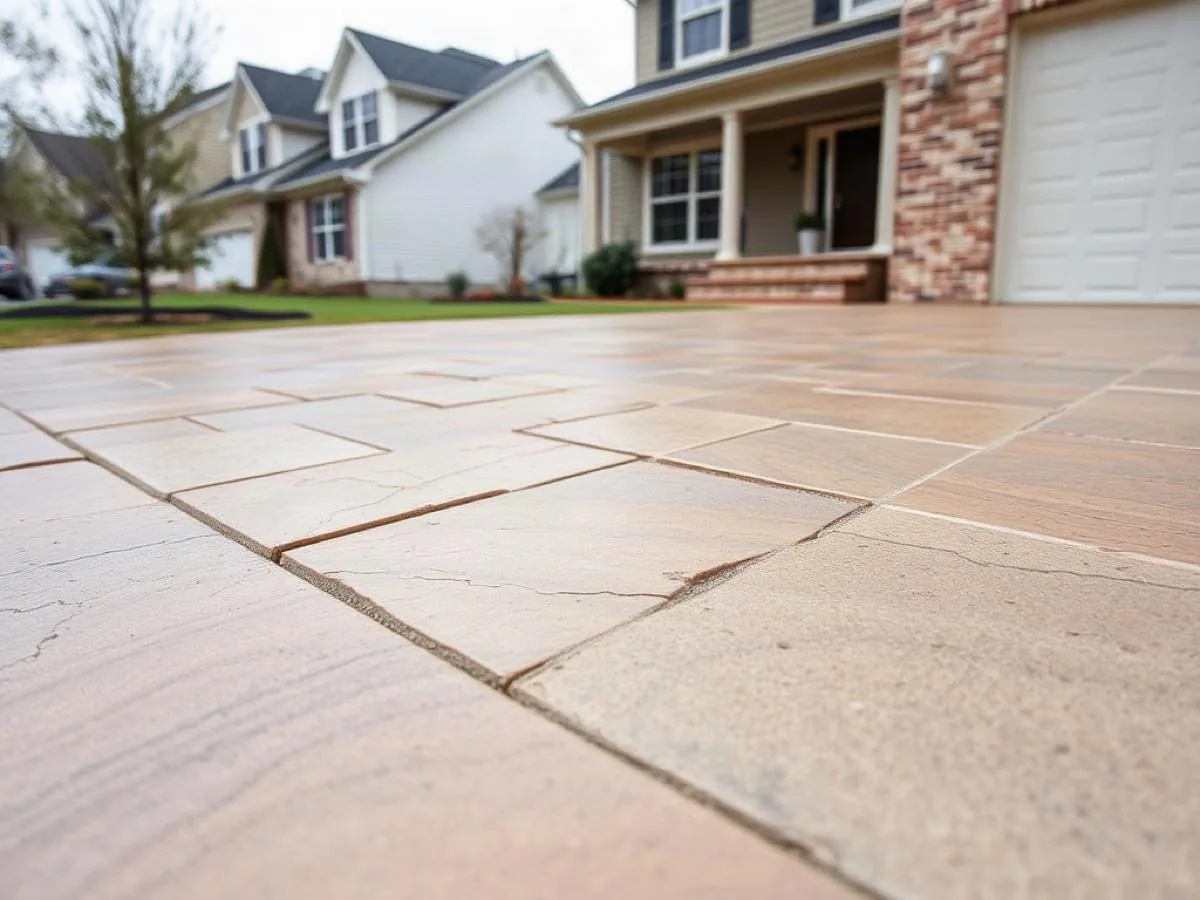
What stamped concrete means here
A texture pressed into the surface while the slab is still plastic. That sounds simple, and the pour itself is. What separates work that lasts from work that fails in five winters is everything that happens before the truck arrives, and almost none of it is visible once the job is finished.
Under most of the Las Vegas Valley there is caliche — a cemented layer of calcium carbonate that the desert has been building for thousands of years. It can sit six inches down or six feet down, and it can be a thin crust or two feet of material that has to be ripped. Caliche is not a problem in itself; it is a good bearing layer once you reach it. The problem is a contractor who quotes a job without knowing where it is, then hits it on day one and issues a change order.
The second factor is sulfates, and it is the one that separates a slab that lasts thirty years from one that spalls in eight. Soils across the valley carry sulfate concentrations high enough that ordinary cement is chemically attacked from below. The reaction expands inside the concrete and pushes it apart. The answer is sulfate-resistant cement — Type II or Type V depending on the exposure class — and it is not an upgrade, it is what the exposure requires. A quote that does not name the cement type has not priced this.
- Thickness
- standard slab thickness for the use
- Mix
- integral colour plus a release agent for the antique tone
- Ready to use
- sealer at 28 days, then every 2–3 years
- Typical cost
- $13-$22 per square foot
- Service life
- 25 years, resealed
How we build it
Base. stamped in one continuous pour, so a patio is a single-day job or it shows a seam. The base is not padding. It spreads load and it drains, so water moving under the slab has somewhere to go. In this valley there is a second question before any of that: how deep the caliche sits. It can be six inches down or six feet, a thin crust or two feet that has to be ripped, and a contractor who quotes without putting a test hole down is quoting a number that will change.
Cement type. 4,000 psi with type ii or type v sulfate-resistant cement, selected from the exposure class of your soil rather than by default. Soils across the Las Vegas Valley carry enough sulfate to attack ordinary cement chemically from underneath. The reaction expands inside the concrete and pushes it apart, so the slab looks perfect for years and then spalls and delaminates from below. A quote that does not name the cement type has not priced this.
Forms and fall. Everything outdoors is pitched to shed water, normally about a quarter inch per foot away from the house. That matters more here than the rainfall totals suggest, because the valley takes its rain in a few violent hours during monsoon season and desert ground sheds water rather than absorbing it. A dead-level slab holds that water against the concrete for days.
Pour and finish. integral colour plus a release agent for the antique tone. Concrete is finished on its own schedule, not ours: float too early and you seal water into the surface, too late and it will not close. Summer here compresses that window to almost nothing — 110-degree air, single-digit humidity and wind pull water off the surface faster than it can bleed up from below, which is what causes the short random plastic shrinkage cracks that appear before the slab has even set. From June to September we start before dawn, the mix carries an evaporation retarder, and the slab is fogged and covered the moment it is finished.
Joints. Control joints are cut about a quarter of the slab depth, spaced in feet at roughly two to three times the thickness in inches. On a four-inch slab that is eight to twelve feet. They do not stop cracking. They decide where the crack goes, and a crack in a joint is invisible.
Cure. Sealer at 28 days, then every 2–3 years. Concrete gains strength by hydration, not by drying out, so keeping moisture in during the first days matters more than the weather afterwards.
What it costs
$13-$22 per square foot for stamped concrete in Las Vegas. Four things move that number: the area, the finish, whether there is an existing surface to break out and haul away, and whether a truck can reach the pour. That last one surprises people. A back garden a mixer cannot reach means the concrete moves by barrow, and the labour on that is real money.
Be careful with quotes that come in well under the range. The savings are usually in the parts you cannot see afterwards: a thinner slab, less stone under it, or a mix without air entrainment. All three look identical on the day the job finishes and all three show up in year three.
The mistake we see most
Stamping needs the right window; too wet and it smears, too stiff and it will not take. We mention it because it is the failure we are called out to fix most often on other people's work, and because it costs nothing to get right at the start.
Related work
Exposed Aggregate Concrete · Stained Concrete · Concrete Staining and Color · Broom Finish Concrete · Salt Finish Concrete · Polished Concrete · Concrete Overlay
Where we pour
We cover Las Vegas, Henderson, North Las Vegas and the wider Clark County valley, including Summerlin, Summerlin South, Henderson, Green Valley, Anthem, Seven Hills, Inspirada, North Las Vegas, Aliante, Centennial Hills, Skye Canyon, Lone Mountain, Providence, Paradise, Spring Valley, Enterprise, Silverado Ranch, Mountain's Edge and 34 more areas.
Questions we get asked
How much does stamped concrete cost in Las Vegas?
$13-$22 per square foot, installed. The spread comes from size, finish and access. A small area costs more per square foot than a large one because mobilising the crew and the truck costs the same either way. We quote on site after measuring, and the price we write down is the price you pay.
How long does the work take?
Most residential work is one to three days on site. Demolition and base preparation take the first day, the pour is a single session, and finishing follows the concrete as it sets. Sealer at 28 days, then every 2–3 years.
Do you handle permits?
Las Vegas County requires a permit for work in the public right of way, which covers sidewalk and driveway apron replacement. Work behind the property line usually does not need one, though impervious-surface limits apply on some lots. We tell you which applies before we quote.
What happens if it cracks?
Concrete cracks; the job of the control joints is to decide where. We cut them at the right spacing for the slab and warrant our workmanship. A hairline crack at a joint is the system working. A crack with one side sitting higher than the other is a base problem, and that we come back for.
Get a free estimate
Tell us what you need. We answer the same day, the free estimate is on site, and nobody chases you afterwards.
Get a price for your stamped concrete
Call (702) 966-9498 and we will come out, measure, and leave you a written quote. There is no charge for the visit and no obligation afterwards.